

Table Of Contents
Bird mesh and bird spikes solve different problems. Mesh forms a barrier around the solar panel perimeter to prevent access beneath the panels. Spikes are used at particular landing or perching spots. Putting spikes elsewhere on the roof does not close an open gap beneath a solar array.
For an established under-panel pigeon problem, Dylan Howell’s approach is to assess the build-up, agree any necessary cleaning and fit a continuous perimeter barrier. Selected perches elsewhere on the building may need separate attention.
Expert insight from Dylan Howell, Director of Australian Gutter Cleaning Co., with 15 years in roofing and eight years in gutter cleaning. Updated 28 October 2026.
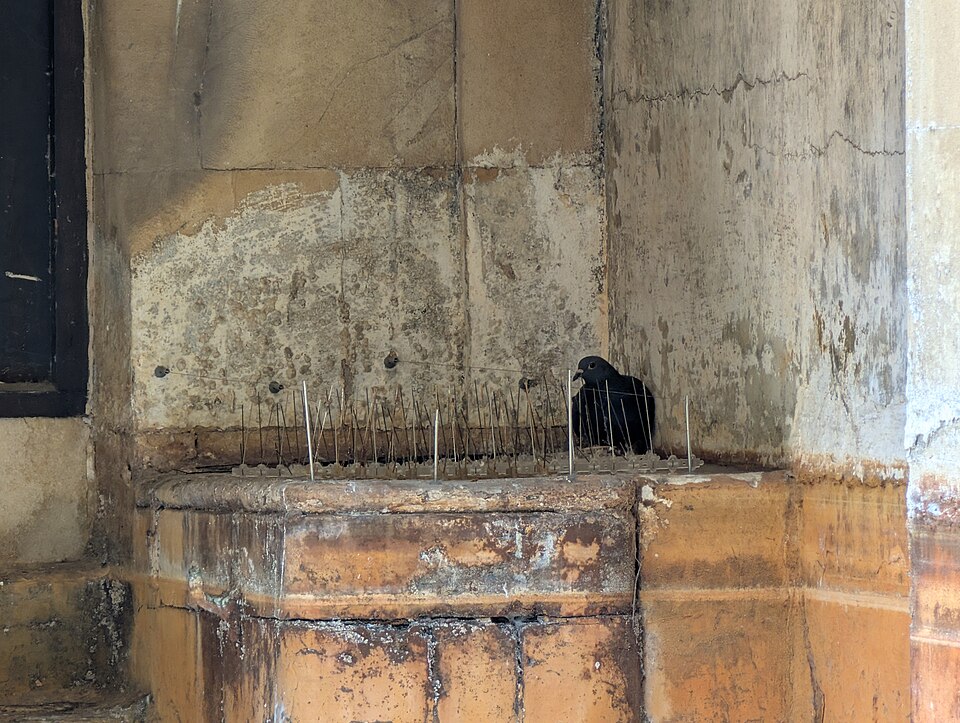
Photo above: a pigeon nesting behind bird spikes at King’s Bath, photographed by Andy Li. This is an illustrative example, not an AGCCO installation. Source and CC0 public-domain licence.

Why spikes can leave the main problem untouched
If pigeons can still reach the sheltered space under the panels, changing where they land elsewhere does not remove that access. A photograph of a bird among spikes shows the limitation of that particular installation; it does not prove that spikes never have a useful role.
Dylan sometimes recommends targeted spikes for other perches, particularly on homes with complex rooflines. The choice depends on where the birds are settling and what remains accessible after the panels are protected.
What AGCCO uses around solar panels
We use PVC-coated aluminium mesh with stainless-steel hook fasteners, attached around the solar panel perimeter. The mesh and fixing method are selected for the installation and location.
This is different from plastic mesh or plastic clips. A protective PVC coating on metal does not make the underlying mesh a plastic product.
Coastal exposure matters when choosing materials and considering their service life. We assess the location rather than treating every roof as the same environment. Our product warranty is three years, subject to its terms.
Corners, joins and gaps deserve close attention
The quality of the installation is not just about the length of mesh fitted. Corners, joins and changes in the roof profile need careful attention so the perimeter works as a continuous barrier.
Dylan recalls a commercial job where an opening left at one corner of another installation allowed pigeons into the enclosed area. A large number became trapped beneath the panels, creating a serious clean-up problem. AGCCO had to remove the existing mesh to gain access.
The customer lesson is simple: material choice and careful fitting both matter. A long run of neatly installed mesh cannot compensate for a missed entry point.
Cleaning and exclusion need to be considered together
When birds have lived beneath panels for years, closing the perimeter is only part of the work. Accumulated waste, nesting material and affected gutters need assessment too.
AGCCO uses industrial vacuum equipment and reach poles for accessible under-panel debris. Heavy or hardened build-up is assessed on site and priced separately. If access requires panel removal, that work is handled by a licensed electrician.
Large accumulations of dried bird droppings require appropriate contamination controls during clean-up. This is a reason to have the work assessed, rather than treating it as an ordinary sweep of the roof.
Will pigeons disappear from the whole property?
Bird proofing targets access beneath the treated panels. Pigeons that have occupied a property for a long time may remain nearby or use another perch. Complex rooflines can provide other sheltered locations that need a separate assessment.
At one Fulham job, an electrician removed the panels, AGCCO cleared years of hardened waste, and bird proofing was fitted after the panels were reinstalled. The pigeons never returned. That is the reported outcome for that job, not a guarantee for every building.
Signs it is time to investigate
- Cooing or scratching around the roof.
- Repeated bird activity at the edges of the panels.
- Droppings and nesting material around gutters and downpipes.
- Vegetation developing beside or beneath the array.
These signs warrant an assessment; they do not by themselves establish the condition of the solar electrics. If the system is not working correctly, contact your solar installer or a licensed electrician.
Which approach suits your roof?
If the problem is pigeons getting underneath solar panels, start with an assessment of the panel perimeter and any existing contamination. If birds are settling on other ledges or roof features, those locations can be considered separately.
See AGCCO’s bird-proofing prices and what affects the quote, or read about our Adelaide bird-proofing service.
Request a quote with your full property address and any known roof or access concerns. If you already have photos, include them; there is no need to climb onto the roof to take any.
Further reading: WorkSafe Queensland: work with bird and bat droppings; Australian Government: looking after your solar system.